New York just challenged the Subscription Economy. Enterprise IT should really be paying attention.
When did buying technology stop meaning you control it? New York is challenging automotive subscriptions, but enterprise software has a much bigger problem: manufacturer accountability, vendor lock-in and the increasingly expensive right to say no.

I’ve written before about the joyous endeavours I've personally had with the software in my BMW X5 and its rather interesting interpretation of modern vehicle ownership. It's a wonderful piece of engineering, and I still love it as a daily. It's packed with technology and all the hardware already installed in the car, but annoyingly BMW required me to pay extra to activate it. One feature even came with an annual subscription.
Apparently these days, buying the car wasn’t quite enough. I also needed "permission" to use certain parts of it. Hmmm...
Well, something rather interesting happened in New York this week.
On the 23rd November, Governor Kathy Hochul signed legislation restricting car manufacturers from charging recurring subscriptions for certain features already installed in vehicles, where those features don’t require ongoing services to function.
Let's take your good aul' heated seats. The elements are installed, the wiring is there, and the car is perfectly capable of warming your tushi without requiring assistance from a remote server somewhere in Munich.
Yet car manufacturers have been closely observing the software industry and have started their own little experiments with charging customers monthly for the privilege.
Thankfully, New York has said enough is enough and decided there should be limits to that business model.
Now I need to be crystal clear, the legislation doesn’t outlaw automotive subscriptions. Connected services and various software-dependent features are still treated differently. And to be far that is rightly so. Providing an ongoing service costs money, and there’s nothing inherently unreasonable about charging for it... so long as you see value in it and you have the choice.
But here's where I draw a line. There’s a fundamental difference between paying for something a supplier continues to provide and paying simply because that supplier retains the ability to prevent you from using something.
And that very notion got me thinking about my industry, one in which I’ve spent decades working in....Enterprise software.
Sure have'nt we been doing this for decades?
The automotive industry may be waking up to the commercial possibilities of software-controlled features, but cmon' let's face it... enterprise technology has been operating with various forms of supplier-controlled dependency for a very very long time.
An organisation acquires enterprise software, spends millions implementing it, integrates it into critical business processes and invests years developing the knowledge required to operate it reliably. At that point, it works. Customers depend on it. Hell, the business depends on it.
Then, somewhere along that road, the manufacturer calls "time" and we now all merrily move on.
Perhaps the product has reached the end of its support lifecycle. Perhaps the licensing model has changed. Perhaps the next version requires a different infrastructure platform. To be fair, there may be perfectly legitimate reasons for some of those decisions. I'm not getting into that today.
But why should the manufacturer’s commercial lifecycle automatically become the customer’s technology lifecycle?
I've talked enough about how personally we'd been good "enterprise software citizens" where we installed the software, followed the compatibility matrices, planned the upgrades and even advised customers to remain within the manufacturer’s supported configurations.
To be fair, we were dealing with highly complex systems where getting things wrong could have serious consequences. We believed we were bring responsible.
It didnt take founding Origina to appreciate that a manufacturer’s willingness to support something and the technology’s actual ability to continue operating are two very very different things.
I mean after all, a support deadline tells you all you need to know about the supplier’s future commitments. But, it is not gospel whether the software has stopped being useful or whether its risks can still be managed responsibly.
Yet. lo and behold we’ve become remarkably comfortable treating those dates as non-negotiable instructions.
And that brings me to something considerably more troubling than paying a few hundred euros for heated seats.

I mean, when does a manufacturer’s responsibility really end?
Ok, let’s go back to my X5 for a moment. I purchased the vehicle, and five years later, it’s outside warranty. Let's say a serious defect is discovered (actually, this did happen - but we'll cover that in another story!) in the braking software. Under certain circumstances, the vehicle could brake unexpectedly and cause an accident.
Can the manufacturer simply shrug its shoulders and explain that your model is no longer supported? Not necessarily.
You see in a country like the United States, vehicle safety legislation requires manufacturers to remedy safety-related defects without charge, even after the commercial warranty has expired. The free-remedy obligation generally has a fifteen-year statutory limit, but stay with me, as the principle is important.
A manufacturer’s commercial warranty and its responsibility for vehicle safety are not the same thing.
Now let's pivot and consider a twenty-year-old passenger aircraft.
A serious vulnerability is discovered in software controlling a safety-critical system. If exploited, it could potentially compromise the aircraft.
Would we simply accept the manufacturer announcing that the software reached end-of-support ten years earlier and suggesting the airline purchase a newer aircraft? Hmm... I can only imagine Michael O’Leary’s response to that particular sales pitch, and I doubt it would be printable!
Aviation operates under a continuing-airworthiness framework. Unsafe conditions can trigger mandatory corrective action, with responsibilities shared between design approval holders, regulators, aircraft operators and maintenance organisations.
Those obligations don’t just simply disappear because a newer aircraft has arrived.
Of course, aviation is highly regulated, and its certification requirements don’t translate neatly into every enterprise software environment.
But the point I'm making is that the underlying question deserves serious consideration.
Like, why should responsibility for software defects be determined primarily by commercial support arrangements rather than the consequences of failure?
Think about that for a second. The very technology supporting hospitals, financial institutions, electricity networks, transport systems and industrial infrastructure (civilisation!).
Some of these systems have been operating reliably for decades. They’re so deeply integrated into environments where replacing them introduces considerable risks of its own.
If a serious vulnerability is discovered, the consequences may extend far beyond the organisation operating the software.
Yet today, the original manufacturer’s willingness to provide a remedy can depend heavily on the customer’s support entitlement and the product’s position in its commercial lifecycle.
Of course it would be impractical of me to suggest that manufacturers should provide free fixes for every software defect forever. Software maintenance requires expertise, engineering investment, testing and ongoing work. New threats emerge, operating environments change, and some systems genuinely become impossible to maintain safely. I get all of that.
But for God's sake, surely we can distinguish between a customer paying for valuable ongoing services and a manufacturer retaining appropriate responsibility for serious defects in something it originally supplied? I firmly believe they dont free pass to just walk away from that.
Where the consequences of failure could be catastrophic, shouldn’t accountability really reflect the true risk rather than just simply the age of the software? Am I mad? Is this not common sense?

Ok... so you want to walk away? Fine. But you don't get to lock the door behind you.
I accept that manufacturers cannot reasonably be expected to maintain every product indefinitely. At some point, a supplier will decide it no longer wishes to support a particular version.
Fair enough. That's your choice... businesses have to make sound commercial decisions.
BUT if a manufacturer wants to walk away from maintaining its software, why should it retain the "exclusive" ability to determine whether anyone else can maintain it?
Remember, the customer has invested in the technology. It remains useful. The organisation has perfectly legitimate reasons for continuing to operate it.
Yet contractual restrictions, inaccessible technical information, proprietary interfaces or other barriers can make independent maintenance unnecessarily difficult.
So... the manufacturer can withdraw its services while the customer remains dependent on its permission to find an alternative. How did we arrive at a position where that seems perfectly reasonable?
I’m not advocating that manufacturers should be forced to publish all their proprietary source code on the internet. There are obvious intellectual-property and bigger security concerns with that approach.
But controlled access to source code for qualified independent maintainers, escrow arrangements, technical documentation, diagnostic tools and appropriate licensing rights can all help create alternatives.
These aren’t imaginary or novel concepts, various forms already exist, and they point towards a principle I believe deserves much greater attention.
If a manufacturer no longer wishes to maintain a product, it shouldn’t be able to prevent others from maintaining it safely and lawfully.
Equally, if a manufacturer insists on retaining exclusive control over how its product is maintained, shouldn’t we demand corresponding accountability for that control?
It seems unreasonable to insist that only you can maintain something while simultaneously reserving the right to stop maintaining it whenever your commercial interests change. Actually, I retract that... it's ludicrous.
Particularly when other people’s businesses, and potentially their safety, depend on the outcome.

The most expensive feature in enterprise software is the right to say "no"...
And there’s another dimension to all of this that I don’t think we discuss nearly enough. Consent.
We all assume commercial agreements are voluntary. A supplier proposes new terms, the customer considers them and decides whether to accept. That’s how business works, right?
Hmmm… in principle.
Take IBM’s recently revised licensing agreements. My colleague Niall Eddery, who has spent over twenty years working with IBM licensing, identified a rather troubling change.
Previously, when a customer stopped paying for Software Subscription and Support (S&S), they lost the benefits of maintenance. Fair enough. But IBM’s revised terms now state that customers with perpetual licences may continue using their software only at the “level in use when coverage lapsed.”
Looks innocent enough... except, as Niall explains, it could mean customers losing the ability to exercise certain perpetual rights they’ve already paid for, simply because they stopped purchasing maintenance.
And this is where it begins to get under my skin. These revised terms can apply to existing customers through qualifying transactions accepting the new agreement from February 2027. What looks like a routine maintenance renewal could have consequences the customer hasn’t fully appreciated.
And even if they do understand, what realistic choice do they honestly have? Refusing could mean disrupting critical support arrangements or contemplating a multimillion-euro migration.
In practice, the cost of refusal may be so high that accepting the new terms becomes the only realistic option available to them.
Now, the legal implications for existing entitlements aren’t entirely settled, and IBM is perfectly entitled to evolve its commercial model, but surely maintenance and perpetual ownership rights are two very different things, right?
To me, this is a classic example of the Software Tax in motion. Not simply the cost of vendor-driven change, but the commercial dependency that makes refusing it so difficult.
A customer with a credible alternative can negotiate over the value a supplier delivers. A customer without one is often negotiating over the cost of disruption. They’re two very different conversations.
I think its about time we stopped assuming that a signed agreement necessarily means the customer had a meaningful choice.
After all, the right to say "no" shouldn’t become another expensive feature that customers have to purchase from their software manufacturer.

But there's a positive signal here.. perhaps the law is beginning to catch up
There are signs that policymakers are starting to recognise some of these issues.
The European Union’s Cyber Resilience Act introduces cybersecurity obligations for many products with digital elements, including requirements around vulnerability handling and security updates.
One particularly interesting aspect is that manufacturers must determine support periods by considering how long a product is reasonably expected to remain in use.
The general minimum is five years, but that isn’t supposed to be an automatic expiry date, products expected to remain useful for longer may require longer support periods.
Industrial control systems, for example, can have operational lifetimes extending well beyond five years.
That’s an interesting departure from the assumption that manufacturers should always be free to define useful product life according to their preferred commercial timetable.
The legislation does have its limitations though, and its principal obligations don’t begin applying until December 2027. It doesn’t create an indefinite right to free software maintenance or automatically solve the problems facing existing enterprise installations.
But... it does introduce a principle worth examining and that is, that the reasonably expected life of a product matters, not simply the date its manufacturer would prefer to stop supporting it.
New York’s automotive legislation addresses a different problem, and neither law establishes the sweeping rights I’m discussing here. But nevertheless, both invite us to reconsider the balance between manufacturers’ commercial freedom and customers’ continuing rights.
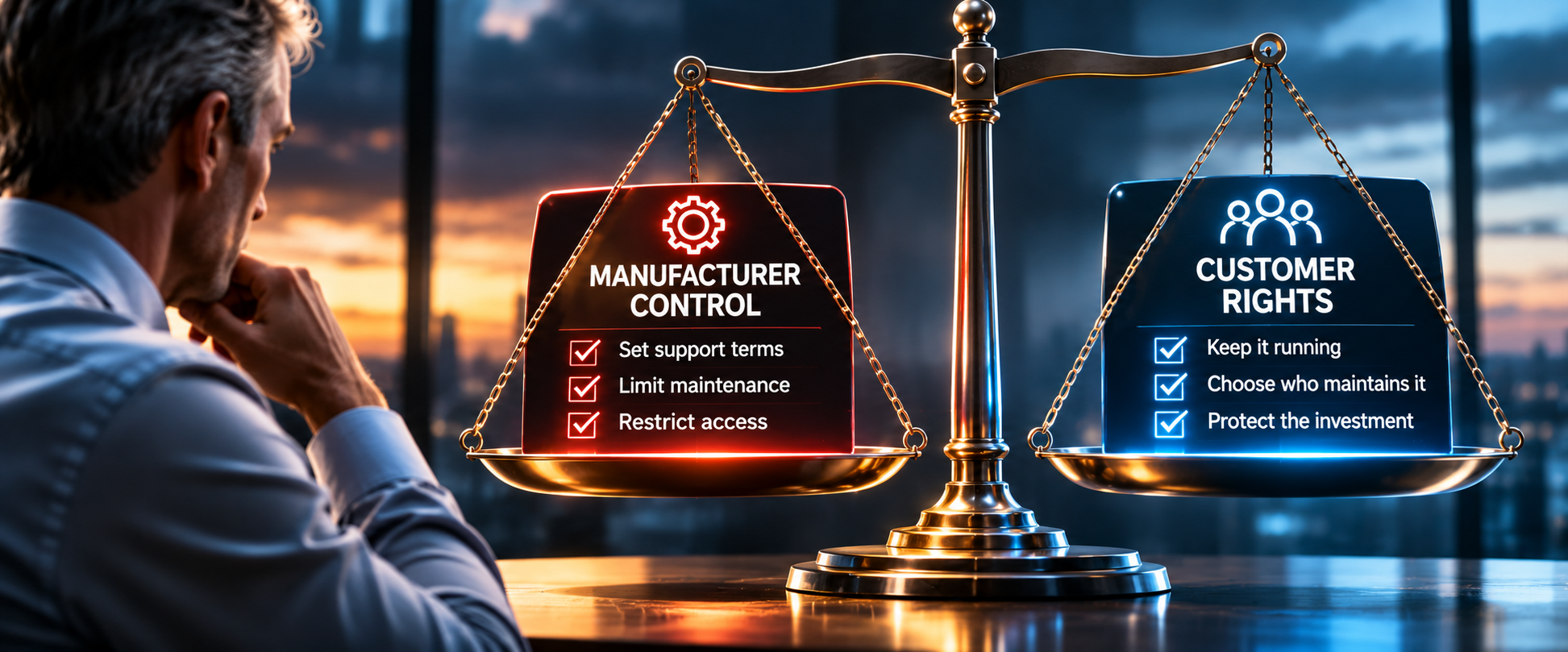
It’s time to rewrite the rules of the relationship
As a techie, I don’t want to return to a world where technology never changes.
Quite the opposite actually.
Some of the most remarkable advances I’ve witnessed throughout my career have come from manufacturers investing in better software, new capabilities and genuinely innovative engineering. 100% they deserve to be rewarded for that.
And customers should invest in modernisation when it delivers meaningful benefits.
But a manufacturer’s commercial ambition shouldn’t automatically become an obligation for everyone who previously purchased its technology.
Nor should ending a support agreement necessarily mean surrendering the ability to maintain a system independently.
I think it’s high time we started demanding a different balance.
Manufacturers should be expected to explain what continuing responsibilities they accept for serious defects in their products, particularly where those defects could threaten safety or critical services.
If they choose to withdraw support, customers should have practical, lawful ways to engage qualified independent maintainers. That might involve controlled access to technical information, appropriate licensing arrangements or other mechanisms that protect intellectual property without making customers unnecessarily dependent.
And CIOs and CFOs need to start treating the ability to refuse vendor-imposed change as something with measurable economic value.
Before blindly accepting the next mandatory migration or licensing transition, understand the impact and what happens if you say no. Its your duty to establish what rights you retain, what risks must be addressed, who else could maintain the environment and what the alternatives would actually cost. Because a commercial choice that cannot realistically be exercised isn’t... well... much of a choice!
Policymakers have a role here too. As software becomes increasingly embedded in the infrastructure our societies depend on, we need a serious discussion about whether manufacturer accountability, independent maintenance rights and reasonable product lifetimes are keeping pace with that dependency. None of this requires us to punish innovation or demand that manufacturers work for free, but it does require us to reconsider an assumption we’ve accepted for far too long: that the company which originally supplied the technology should also have the final say over how long it remains useful and who is permitted to maintain it.
It is great to see that New York has begun questioning one small part of that arrangement in the automotive industry, but I think enterprise technology leaders should be asking much bigger questions.
After all, if we’re prepared to challenge recurring charges for the heated seats in a car, surely we should be willing to challenge the commercial dependencies surrounding the software that keeps hospitals operating, aircraft flying and critical infrastructure functioning.
A manufacturer should be free to stop selling a service, but what shouldn’t automatically follow is that the customer must lose the freedom to keep using and maintaining the technology.
And perhaps it’s time we stopped treating the right to say no as a privilege granted by the supplier.
It should be a meaningful choice retained by the customer.